Keeping the Heat In – and Out
How Curtains, Blinds and External Shading Can Help Create More Energy-Efficient Buildings
By Paul White – Raex Motors
For generations, curtains and blinds have primarily been viewed as ways to provide privacy, control daylight and complete an interior design scheme.
Increasingly, however, shading is being recognised for another important role: temperature management.
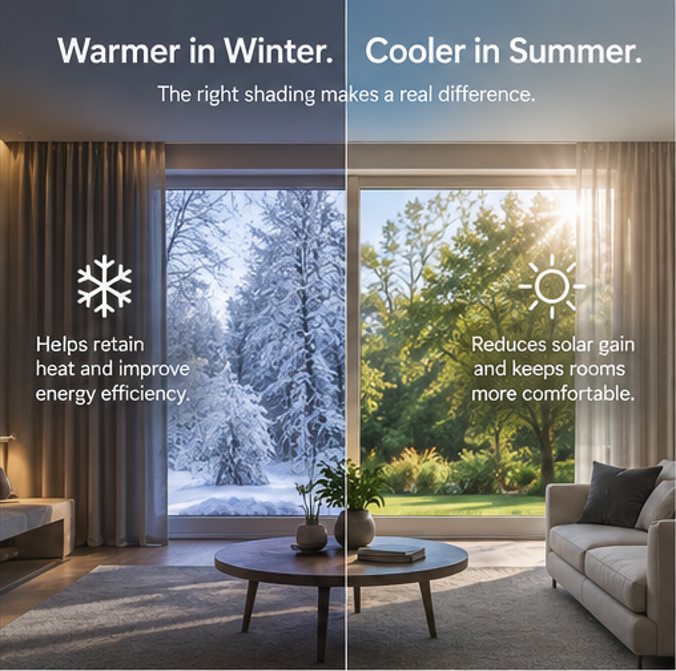
In winter, correctly used curtains and blinds can reduce heat loss through windows. In summer, internal and particularly external shading can reduce the amount of solar energy entering a building, helping rooms remain cooler.
With UK summers becoming warmer and periods of extreme heat more frequent, this is becoming increasingly relevant. Government guidance now specifically identifies shading as one of the passive measures that can help reduce overheating in buildings.
For architects, interior designers, blind retailers, installers and smart home integrators, shading therefore deserves to be considered as part of a building's thermal strategy – not simply its decoration.
Why Windows Matter
Even high-performance glazing represents an important part of the thermal envelope of a building.
During winter, heat naturally travels from the warmer interior towards the colder exterior. Windows therefore contribute to heat loss from a property.
During summer, the problem reverses.
Solar radiation passes through glazing and is absorbed by floors, furniture and other internal surfaces. These subsequently release that energy as heat.
Anyone with a heavily glazed south- or west-facing room will recognise the effect. On a sunny day, temperatures can continue rising even when the outside temperature itself is relatively comfortable.
Shading gives us a surprisingly simple way of influencing both processes.
Keeping Warm in Winter: Can Blinds Really Reduce Heat Loss?
Yes – and the difference can be significant.
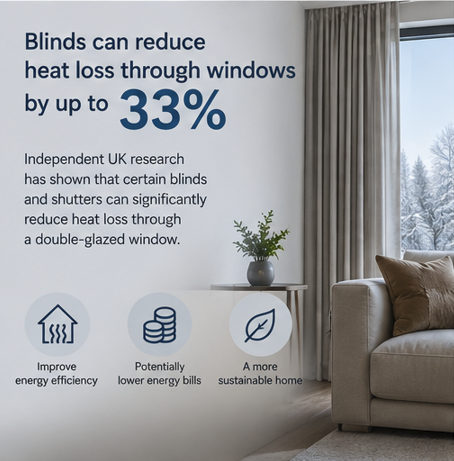
Independent testing carried out at the University of Salford's Energy House laboratory for the British Blind and Shutter Association examined several shading products fitted to a modern double-glazed low-emissivity window.
Depending on the product and installation, reductions in heat loss through the window of up to 33% were measured.
The results included:
- Standard Roller Blind – Up To 13% Reduction In Window Heat Loss
- Roller Blind With Side Channels – Up To 22%
- Internal Plantation Shutter – Up To 28%
- Framed Blackout Honeycomb Blind – Up To 32%
- Low-Emissivity Roller Blind With Zip Side Channels – Up To 33%
These figures refer specifically to heat loss through the tested window, rather than a 33% reduction in the property's total heating bill. Nevertheless, they demonstrate that window coverings can make a measurable contribution to thermal performance.
The principle is straightforward.
Closing a blind or curtain creates an additional layer between the warm room and the colder glazing, reducing heat transfer.
Curtains Can Help Too
The same principle applies to curtains.
A well-fitted curtain creates an insulating air layer between the fabric and the window. Heavier fabrics, linings and curtains that provide good coverage can improve the effect.
However, how shading is used matters almost as much as the product itself.
On a sunny winter day, opening curtains and blinds allows useful solar energy into the room.
As daylight disappears and temperatures fall, closing them helps retain some of that accumulated warmth.
Think of shading as a dynamic thermal layer rather than something permanently open or closed.
This is also where motorisation becomes particularly interesting.
Summer Changes the Equation
During hot weather the strategy effectively reverses.
Rather than allowing solar energy into the building, the objective is to prevent excessive heat gain.
UK Government hot-weather guidance recommends shading or covering windows and specifically identifies curtains, internal blinds, external shutters, roller blinds and awnings as measures that can help reduce overheating.
Homes with large east-, west- or south-facing windows and little shading are recognised as being particularly vulnerable.
But there is an important distinction between internal and external shading.
Why External Shading Is More Effective in Summer
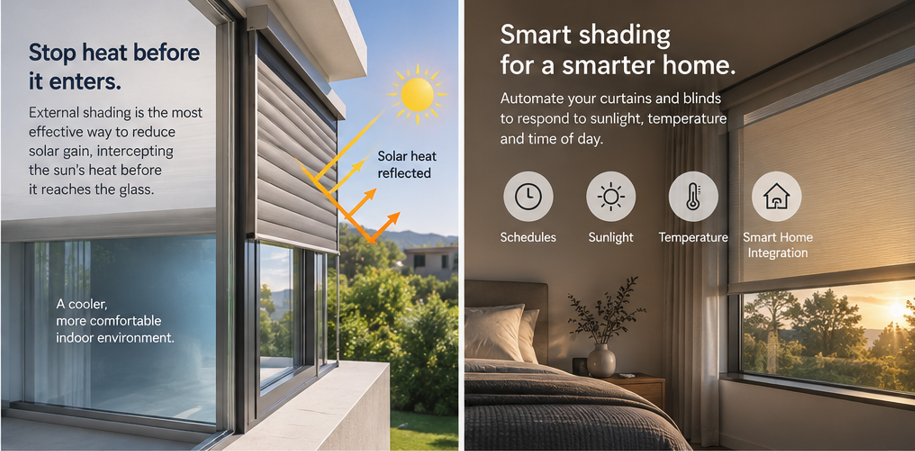
External shading has a fundamental advantage: it can intercept solar radiation before it reaches the glass.
An external blind, shutter or awning effectively creates a shield between the sun and the building.
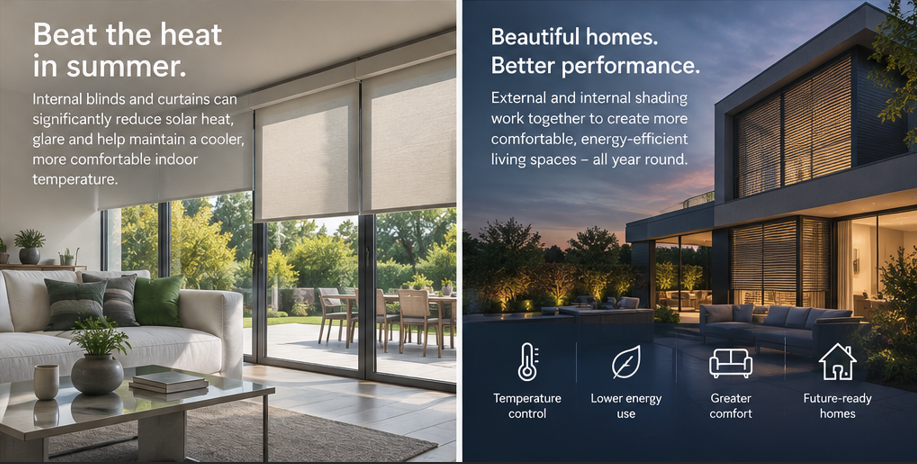
Internal blinds and curtains operate after solar radiation has passed through the glazing. They still make a substantial difference – particularly when reflective or specialist solar-control fabrics are used – but some of the solar energy has already entered the building.
This is why external shading is so common in warmer European climates.
The potential effect can be considerable. Research cited in the Government's 2026 Warm Homes Plan examined overheating in London apartments. External shading combined with night ventilation reduced indoor temperatures by 11–18°C, while internal blinds alone achieved reductions of 9–13°C under the study conditions.
That does not mean every property will experience reductions of this magnitude; orientation, glazing, ventilation, weather and shading type all influence performance.
It does demonstrate just how significant shading can become when overheating is severe.
Can Shading Actually Save Money?
Potentially, yes – in two different ways.
During winter, reducing heat loss means the heating system has less work to do to maintain the desired room temperature.
During summer, reducing solar gain can decrease the requirement for fans, comfort cooling or air conditioning.
The precise financial saving in a home cannot sensibly be expressed as a universal pounds-per-year figure because it depends on glazing area, orientation, energy tariff, heating system, shading product and occupant behaviour.
Commercial modelling provides an indication of the potential scale, however. Research highlighted by the BBSA found that, in a model office, internal Venetian shading could reduce HVAC energy use by around 10%, while screen roller blinds achieved 23%. With external shading, the modelled reductions were 43% and 47% respectively.
These are modelled commercial-building figures rather than guaranteed household savings, but they demonstrate why solar shading is increasingly considered part of energy-efficient building design.
The Missing Ingredient: Automation
The biggest limitation with manually operated shading is simple: somebody has to remember to use it.
A blind that could prevent solar gain provides little benefit if it remains open throughout a hot afternoon.
Likewise, curtains cannot help retain warmth on a winter evening if they remain open until bedtime.
Motorisation changes this.
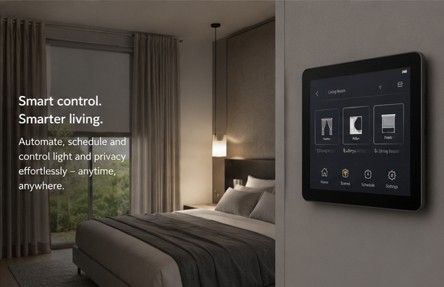
Electric curtain tracks, motorised Roman blinds, roller blinds and external shading can increasingly be connected to smart home or building management systems.
Depending on the system, operation can be based on:
- Time Of Day
- Sunrise And Sunset
- Room Temperature
- Solar Intensity
- Season
- Occupancy
- Smart Home Scenes
Imagine a west-facing room on a hot summer afternoon.
Instead of waiting until the occupant notices that the room has become uncomfortable, automated shading can close before excessive solar gain occurs.
In winter, the opposite strategy can be used: shading remains open while useful sunlight enters the room and closes around dusk to help retain warmth.
That is when motorised window treatments move beyond convenience and become part of the building's environmental control strategy.
Internal or External Shading: Which Is Better?
There isn't one answer for every project.
For preventing summer solar gain, external shading generally has the advantage because it deals with sunlight before it reaches the glazing.
However, external systems are not practical on every property. Planning, architecture, wind exposure, maintenance, window design and cost can all influence the decision.
Internal shading remains extremely valuable.
Curtains, Roman blinds and roller blinds can provide thermal benefits in winter as well as reducing solar gain during summer. Specialist reflective and solar-control fabrics can further improve summer performance.
In many projects the best solution may involve a combination of internal shading, appropriate glazing, ventilation and – where practical – external shading.
Designing for a Warmer Future
The conversation surrounding shading is changing.
It is no longer simply:
"Which blind looks best at this window?"
Increasingly, architects, designers and homeowners are also asking:
"How will this room perform in January – and how will it perform during a heatwave in July?"
That question will become increasingly important as buildings become better insulated and UK summers become warmer.
The most successful shading strategies recognise that our requirements change throughout the day and throughout the year.
In winter, we want to capture useful solar warmth and retain it.
In summer, we want to prevent excessive solar gain and release accumulated heat when outside temperatures fall.
Dynamic shading allows us to do both.
A Final Thought
Curtains and blinds will always play an important decorative role, but their contribution to the performance of a building should not be underestimated.
Evidence now shows that correctly selected shading can reduce heat loss through windows in winter and significantly reduce overheating in summer.
When motorisation and intelligent controls are added, that shading can respond automatically to changing conditions rather than relying entirely on the occupant.
For architects, interior designers, retailers and smart home integrators, this creates an opportunity to think about motorised curtains and blinds differently.
Not simply as window coverings, but as an active part of a comfortable, energy-conscious and increasingly climate-resilient building.
At Raex Motors, we work with architects, interior designers, blind manufacturers, retailers and smart home professionals to specify motorised curtain tracks, Roman blind systems and roller blind motors for residential and commercial projects.
Early consideration of shading, power and control requirements can help ensure that the finished solution works not only aesthetically, but as part of the wider building strategy.